Hope is Real
Nearing the end of the second volume of Maus, Art Spiegelman starts to focus more on hope instead of the morbid and draining aspects of the Holocaust. He includes the first and only real photo in the book on this page. This is the photo Anja held when she was first sure that Vladek had survived their time apart, and her hopes of seeing him again were given true life. Including this photograph here shows that hope is so powerful it must be represented by something real; anything else would not have sufficiently represented the magnitude of her feelings, and the real and dominating presence of hope.
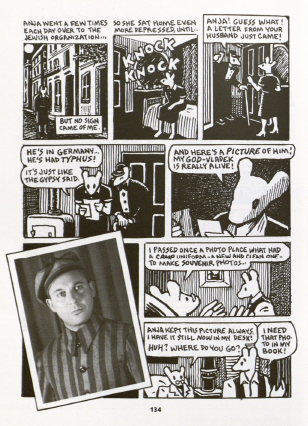 In this photo we see a very healthy, proud-looking Vladek, dressed in prisoner's clothing. This is an inaccurate representation of what he and the other prisoners looked and felt like during the war. Spiegelman is demonstrating that small, surface-level depictions of the war cannot ever accurately represent the relationship between past and present, imprisonment and freedom. Even his comics cannot truly convey how it felt to live as a Jew during Vladek's time.
Beside the photo, Spiegelman works the text to create a sour irony. In one panel, the words "camp" and "souvenir" are bold. These words are being used to describe the photo, which is a souvenir of the prison camps. While these words hold the connotation of a desire to fondly remember something, we know that the real horrific memories haunt Vladek every day. Spiegelman is almost mocking the photo along with the world's poor and failed attempts to understand what the Holocaust did to people.
The inclusion of a photograph draws readers away from the allegory of the overall comic, reminding us that these mice represent real human beings who have suffered. While this realization is depressing, we are also reminded that hope is real, and we feel Anja's relief and optimism.

Comments
Post a Comment